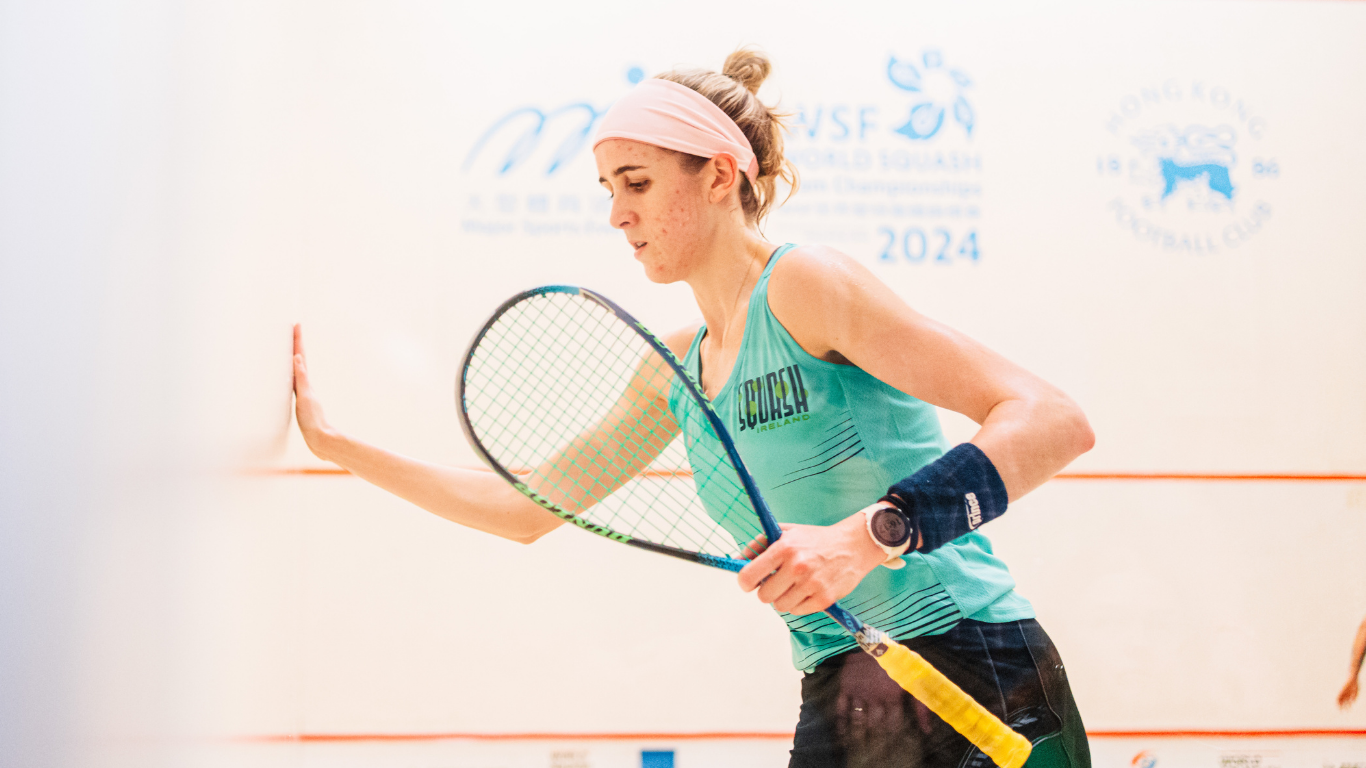
Breanne Flynn is rested, refreshed and ready to go again following the hectic start to the 2025/26 campaign that lifted her to No.111 in the PSA rankings, seven places off the 104 career best set in October 2022.
At that time three years ago, she was juggling sport with her work as a full-time physiotherapist. Now, though, she is all in with squash and determined to achieve like never before on the world circuit.
Having recovered from breaking a metatarsal in her foot last March in Denmark, the 30-year-old has clocked up the miles in getting her game up to scratch in recent months. After coaching and providing physio to the Ireland U19s at the World Junior Championships in Egypt in July, she got stuck in herself on court.
Six tournaments later – two in Australia, one in France, another in Ireland and two more in the USA – she has drawn breath, fine-tuning her play in recent weeks at either her girlhood club in Sutton or at Fitzwilliam and getting the logistics sorted for another upcoming travel flurry.
Andorra next Tuesday, followed by November trips to Monte Carlo and Germany, are on her immediate radar, and the ambition is clear – to soak up as many ranking points as possible and potentially transform her current No.118 position into a highest-ever spot.
Fresh off the training court, Flynn told Squash Ireland: “They all have good points on offer. The goal is just not to be afraid of any opponent and to just see what can happen,” she enthused.
“I’m definitely at my peak. I am feeling physically really fit, probably the fittest I have ever been. Building up the quick-fire speed and things like that after the injury. Yeah, I am feeling in really good physical shape.”
No player ever likes getting injured, but the knock Flynn sustained seven months ago in Odense afforded her the time to plot this season’s assault up the rankings, which has so far included a title win in Dublin and a runners-up spot in Rochester.
“When I was off injured, I took a bit of a step back and tried to educate myself about different aspects of the game, such as the mental part of squash, which is huge,” she revealed.
“I started tapping into those sorts of things, read some good books and I have actually started a bit of practice on myself. That is included in my training regime now, which is going to help give me the edge this season.
“Aside from playing squash, I’m in the gym pretty much five or six days a week as well. And then just the off-court stuff, I have linked in with our national coach Arthur Gaskin about visualisation, game plans and all sorts of different things like that, so they all make a difference.”
Of great help was her ‘have racket, will travel’ attitude towards getting back into the swing of squash a few months back. “I’m definitely coming at this season differently from others. I fractured my fifth metatarsal in March and when I got back on court training in July, all the advice I was given was to play tournaments.
“It didn’t matter about the results, just play, put myself out there and get myself back into match play as soon as I could, so that is what I did essentially. I decided to go further afield because there are not as many competitions in the summer in Europe.
“I went to Australia straight after Cairo (assisting the Ireland juniors), which was a great experience as a physio and coach. We had a great team environment and that is when the sport becomes really fun, when you can all get together to represent Ireland and do the best you can.
“I went straight to Australia after that to get the cobwebs out of my system and came back straight back into the European Individuals, which again was more match play. I could see slowly, week by week, that I was getting better and better, and I guess I actually peaked for the 3K PSA in Fitzwilliam, which I was able to win.
“It was great to win a PSA at home. It was really enjoyable, and then I had good results in America as well. Although it was a very busy start to the season, it worked well in that it made me confident in my movement on court.”
She is inspired by what is now on her immediate horizon. “I’m entered in a 12K, a Copper event and I’m going to have maybe two 6Ks before Christmas. Definitely a goal would be to try to win the 6Ks and then for the 12K and the Copper, it’s to get through as many rounds as possible, to take it one match at a time.”
Going full-time in squash was something Flynn didn’t envisage in her early 20s. Born in the USA before moving home to Ireland as a two-year-old with her family, the Dubliner had returned to the States for her medical tuition.
“I did my undergraduate degree over in America, I got a scholarship to play squash at George Washington University in Washington DC, so I did that for four years and studied exercise science while playing the college squash circuit over there,” she explained.
“When I decided I wanted to be a physio, I came home and did the masters in physiotherapy in UCD for two years. I was training and playing squash, but I was also studying a lot. That was quite difficult.
“At the time, nobody suggested PSA would be an option, so I didn’t even think of it. But then, in the aftermath of covid, I started working as a full-time physio and Squash Ireland got funding for PSA training and things like that. That came about basically when I was two years qualified.
“So I was two years qualified, working in a hospital, but then I was able to avail of training with the Squash Ireland PSA hub. I started to do that and was trying to balance training and working.
“It was getting harder and harder every year, so it was just a year and a half ago that I decided I wanted to give squash its proper due and go for it.”
The travel bug has certainly bitten Flynn, although her trip with the Irish juniors to Egypt was a sharp reminder to always pack carefully. “All of the other players playing the PSA tournaments are in the exact same boat as you, so there is no shortage of people to train with when you are travelling.
“From that sense, the training is always good before and even after tournaments as well. You just have to plan things ahead of time, contacting promoters, booking things in advance, booking courts – everything is a little different from home.
“Even with regard to thinking about food and things like that. Certainly, in Cairo, that was a whole new world for us when we were trying to fuel properly for matches and trying to recover properly, but we couldn’t eat all the food over there.
“You do have to think about those things in a lot more detail. I have definitely started bringing a lot of food in the suitcase with me, more as a safety measure because I learnt my lesson the hard way.
“I’ll definitely have High5 electrolytes, I’ll have the Nakd protein bar that just has the five ingredients, and then I’ll always be bringing my Flahavan’s oats in a little plastic pocket and protein powder as well.”
In time to come, once she has become a top 100 regular and started to play in the better PSA tournaments, representing Ireland at the 2028 Olympics in Los Angeles can hopefully become a target.
“It’s hugely exciting that squash is in the Olympics. I guess the slightly disappointing element is that it’s more of a showcase of the sport, the fact that it’s only 16 men and 16 women competing. That’s maybe a little disheartening because we are not sure what the qualifying process looks like.
“But if you take a step back, it’s such a positive step for squash in general. The sport can only grow from being in the Olympics. It will only get more and more popular.
“It’s important that we invest in it and invest in our juniors and grassroots to try to get the numbers up in Ireland because then we can develop professional players at a higher volume, which will give it a great chance to be represented in the Olympics in the future.”