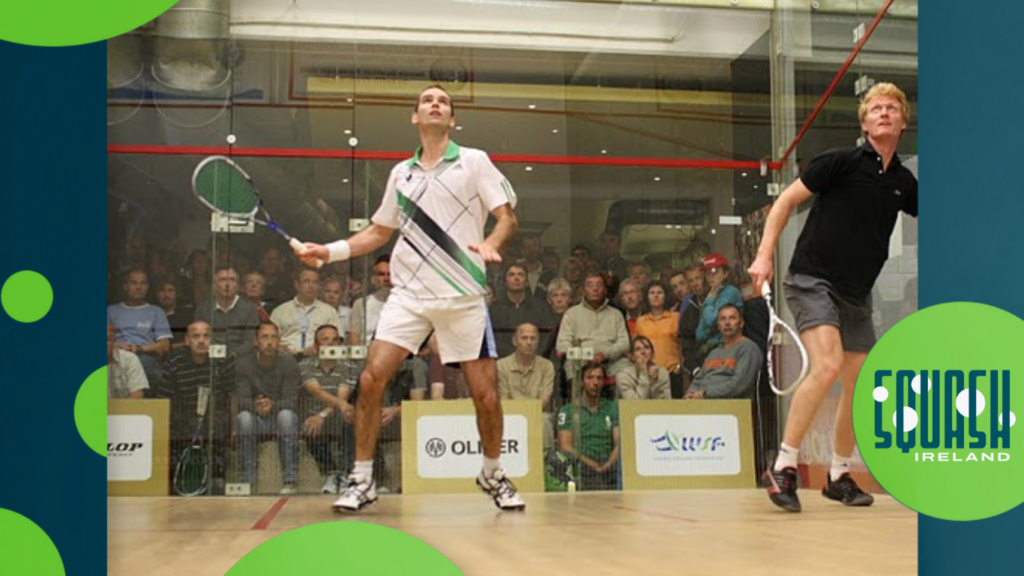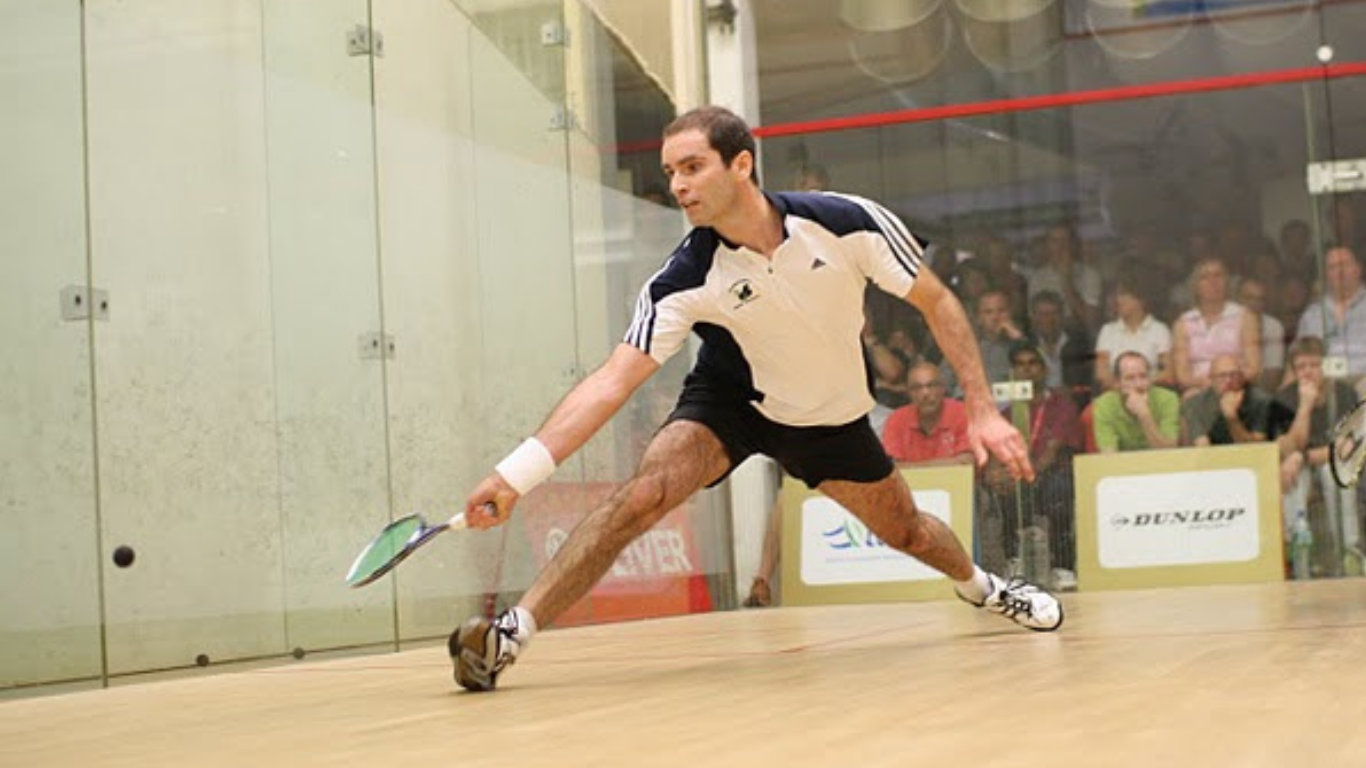
Irish squash royalty Derek Ryan was back at it this weekend, winning titles in Fitzwilliam. The Leinster Masters Open M50+ doesn’t have the same cachet as the nine Irish Nationals won by the former PSA men’s world circuit star. However, the 56-year-old Dubliner showed he still has what it takes despite rarely picking up his racket nowadays.
“I have been out of the game for probably 18 months apart from playing four or five times, so I want to get back playing,” Ryan told Squash Ireland before putting on his kit and getting into the swing of things. “I’m throwing my hat in the ring because I need to get back playing.”
It’s now 14 years – 2012 – since his last Irish Nationals victory, long after he had pulled the plug on the stellar pro career where he became world No.7. Memories of this rip-roaring adventure remain vivid, especially the mid-1990s epiphany that transformed his squash, turning him from a journeyman into a force threatening the upper echelons.
“I couldn’t have done it on my own,” he explained, quick to highlight the importance of people in his corner. “As a junior, you really need a good coach. It’s so invaluable, and I was lucky I had a very, very good coach called Alan Jerrold.
“He was quite a grounded individual, never made a drama. Everything was very consistent with his sessions. He was very technical, very organised, and he put on a lot of sessions for us as juniors as we went into seniors.
“There were always summer camps. I would probably have gone seven or eight weeks in a row, Monday to Friday, doing four to five hours a day – and you need that level to improve.
“But the epiphany moment was when I was 23. I went to England at 19 to play professionally and although I was playing hard on court, I wasn’t doing the right training and would have considered myself lazy.
“I knew that. I wasn’t strong enough. I mean, I was quite lean and wasn’t doing the right strength training. Back then, the guidance wasn’t what it is now with sports science and research.
“A fellow pro, who was probably a few years older than me, turned around and said, ‘If you want to keep playing professionally at 27 years of age, you’re going to have massive regrets if you don’t put in the work now’.
“I was never lazy on court, I would give absolutely 100 per cent on court in a league match, in a tournament, in practice. But I didn’t do enough of the gym work, didn’t do enough cardio. I’d rather just go on court and play and that wasn’t good enough.
“It was a real wake-up moment because it gave me a kick up the backside and I went to get a new coach. Not that I had left Alan, it was just that I was in the UK and Alan was in Ireland. We would still communicate and when I was home, he would watch my matches and whatnot and still do a bit of work.
“But I needed to evolve in the place I was living. I reached out to Chris McManus, who lived near Manchester and used to play internationally for Scotland. I asked if he could coach me and we clicked, became very good friends and still are today.
“He changed my game and got me working with a strength and conditioning specialist, but he was also a physiotherapist who worked with the marines. He did their training and was a tough guy but also just clever, very sports science directed and I started training properly.
“The results didn’t come; I had a really, really tough four months and probably had a very average season, but when I did the following summer of really training properly, I started to see results and then made a massive jump in my ranking. That was when I trained properly, from 23 on. That would have been the epiphany moment.”
Living in England hardened Ryan for the relentless grind. “There are a lot of knocks in squash when you go professional,” he explained. “A hell of a lot of knocks because the results are very hard to get. You are playing guys who are hungry as well and may have had a better sort of squash background than you did.
“You could only get so high in Ireland. There is a bigger ceiling beyond Ireland; it’s the same for most countries apart from Egypt, and you need to earn self-belief. I only found this out a few years after being on the tour.
“Anybody can be confident. You can get up in the morning, look yourself in the mirror and go, ‘I am going to have a fantastic day today, I am going to play great today’. Anyone can get confidence, but confidence can be shattered by one comment from somebody whereas people don’t shatter your self-belief.
“You earn it yourself and realise you start competing better, you lose in four sets to someone that would always beat you 3-0, but it was very tight in the fourth set. You earn that self-belief that I can actually beat this person and then all of a sudden, the day comes when you do beat them and that self-belief stays with you as long as you keep topping up your training and you are being disciplined. That was a big thing for me. That was self-belief and earning it.”
Of great help was Ryan’s willingness to chance his arm for better exposure. After a year of training full-time and playing in local Manchester leagues and tournaments around the UK, he began chasing participation in PSA events, essentially putting what little money he had where his mouth was.
“Reserves don’t generally travel to decent-sized tournaments, but I just thought someone was not going to turn up here. I was prepared to buy my ticket, pay for my hotel, and if I didn’t get in, I didn’t get in.”
With his game improving, though, securing qualification through the qualifiers became a more frequent route. “I just kept turning up for these qualifying events and if I got in, I was surrounding myself with some of the best players in the world.
“I was playing with people at a very high level, and it dragged my level up and that was the big thing for me. That is the big thing I would say to any junior: surround yourself with better players and good mentors, good coaches. You’re constantly getting good feedback from people.”
His highlights were numerous, as revisited in this accompanying Squash Ireland Q&A piece (click here), and it was summer 1999 when he revelled in his rankings peak. Unlike now, where PSA updates its rankings weekly online, back then it was monthly and unless you arranged to get the chart faxed to you, it arrived in the post.
“It would literally be like waiting for (exam) results, you’d open the envelope and here are the new rankings,” he said, recalling he was in Finland when the best news arrived. “I was training for two months with the Finnish players and the rankings came out.
“They were all checking and it was the first time I broke into the top 10. I hit No.10 or No.9. I had a good season, so they were all congratulating me and it was a good buzz.”
Aside from ultimately becoming world No.7 later that summer, Irish Nationals success was also huge for Ryan. “It was tough winning my first one because Willie Hosey was winning titles before I arrived and he was a generation ahead of me, probably about 10 years between us.
“They were memorable finals and were a big deal. Like, they were packed houses. There wasn’t a seat in the house. There was a really good sort of gladiatorial feel to it. He has his people in my corner; I had my people in my corner.
“They were good battles. Like, massively memorable and you wanted to win them. And when you won one, you wanted to keep going back and winning another.
“A lot of the time they were on just before Christmas, so I would have been on the world tour and always wanted to come home for Christmas, so it was a nice bonus having that tournament just before it, sort of at the halfway stage of the season.”
Ryal left squash, going to university as a mature student to qualify as a physiotherapist, but squash never left him. He runs his practice from a base at Fitzwilliam and since 2017, he has also worked on the PSA world tour, either providing lead physio services himself at seven or eight tournaments annually or arranging for others to attend.
His next event will be in April in El Gouna, a trip to Egypt that heralds a busy end to the 2025/26 season. He loves the work. “It reconnected me with the sport because when I retired, I went straight into full-time education for four years and then started my physio career, so I sort of stepped away from squash.
“Not that I didn’t like it, I was just busy with other things. But this really helped me to reconnect with the sport and a new generation of players who are super exciting, and it also got me back playing a little bit of squash again.
“It also got me working with some players on the strength and conditioning side. In 2018, I started working with Ali Farag, worked with him right up until he retired last year. That gave me another dimension to what I do in my working month, and it opened up the door to working with other players.
“I have worked with quite a few PSA players, although Ali’s retirement was a big shame but great for him as well – seven years working together was amazing. Amazing athlete to work with, amazing person to work with and I consider him a good friend, so we always keep in contact.
“I also work with Mostafa Asal, so I am super fortunate that PSA opened the door for me to work with these players. I am grateful to them for opening that door.”
Lately, Ryan has also started giving back to squash locally, doing S&C sessions with the teenagers in the new Squash Ireland Junior Performance Academy. It’s been refreshing, even if plenty of the potential stars of tomorrow still mightn’t be aware that he was once a star of the global game.
“It’s interesting, some of the players just see me as this strength and conditioning guy or a physiotherapist and I’d imagine some of the players don’t even know I was an ex-player,” he said.
“I certainly don’t stand on court and say I was A, B and C. Some of their parents may know, but I’d imagine some of the players are looking at me going, ‘What does he know about squash?’ Over time they will know and will appreciate that I can give a good bit of mentorship and input to them and into their careers and hopefully the plan is to travel away with a couple of the Irish teams, with the coaches.
“Connecting with the coaches and me will create something special for the players that maybe some other countries won’t have, that access to that experience, the mentorship, the connection, so in the future there should be good productivity with this alliance.”
What has he been advising Ireland’s future stars? “Commit to the sport, spend as much time as you can on court and don’t overtrain but train and train cleverly. Do the right amount of training, use strength and conditioning gym work to reduce the risk of injury rather than necessarily just to get stronger.
“You will get stronger by doing it, but it’s more to reduce the risk of injury. If you reduce the risk of injury, then the likelihood is that you are going to spend more time on court. If you overtrain and do too much, that’s when you can start getting niggles and you then can’t really put as much time into the court. Surround yourself with better players but yeah, get on court as much as you can.”