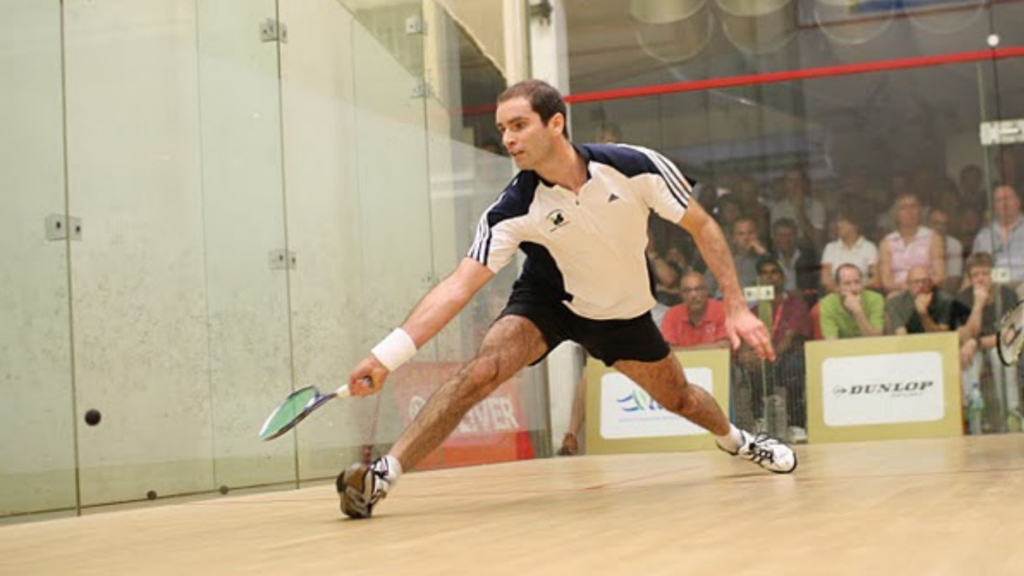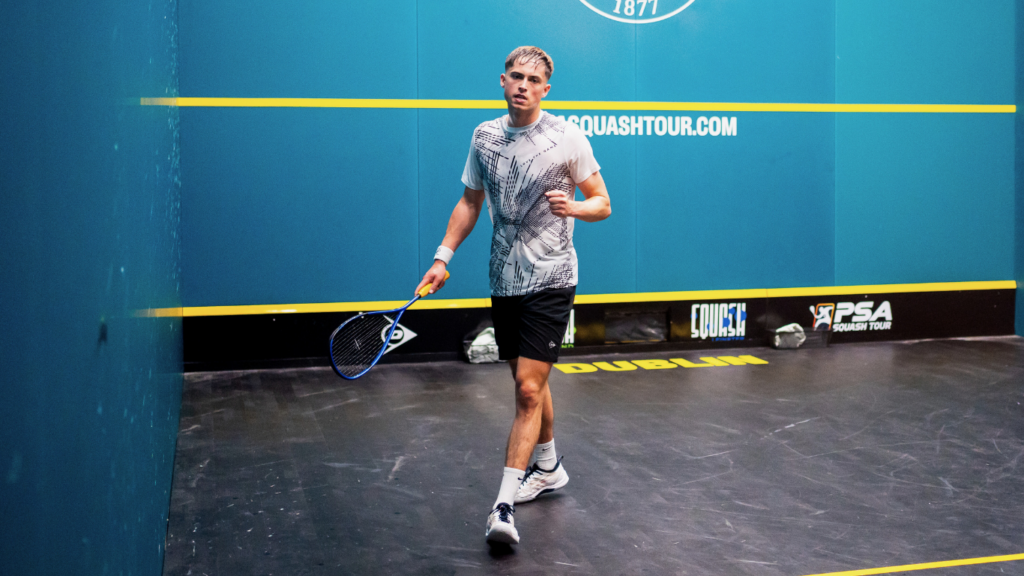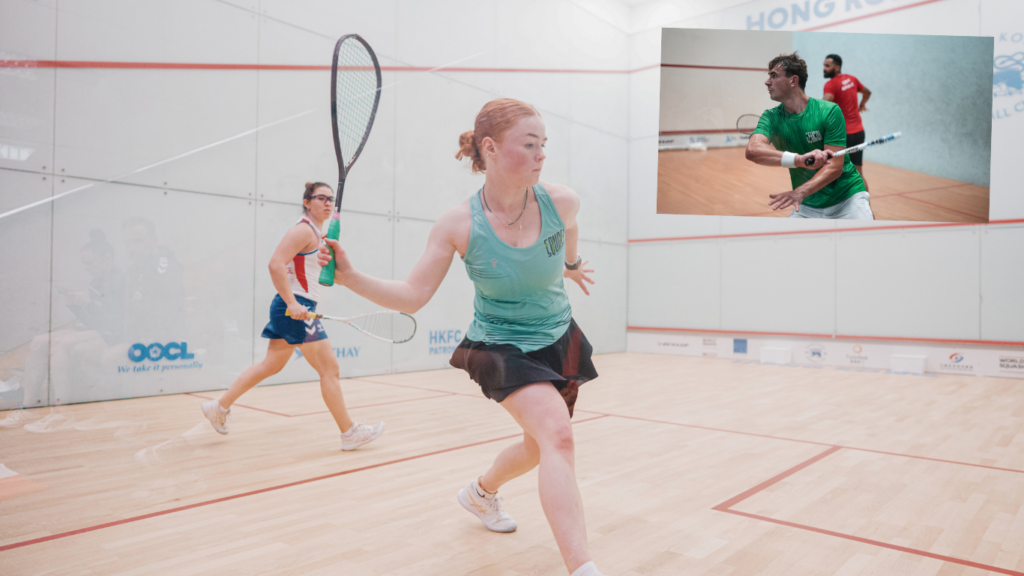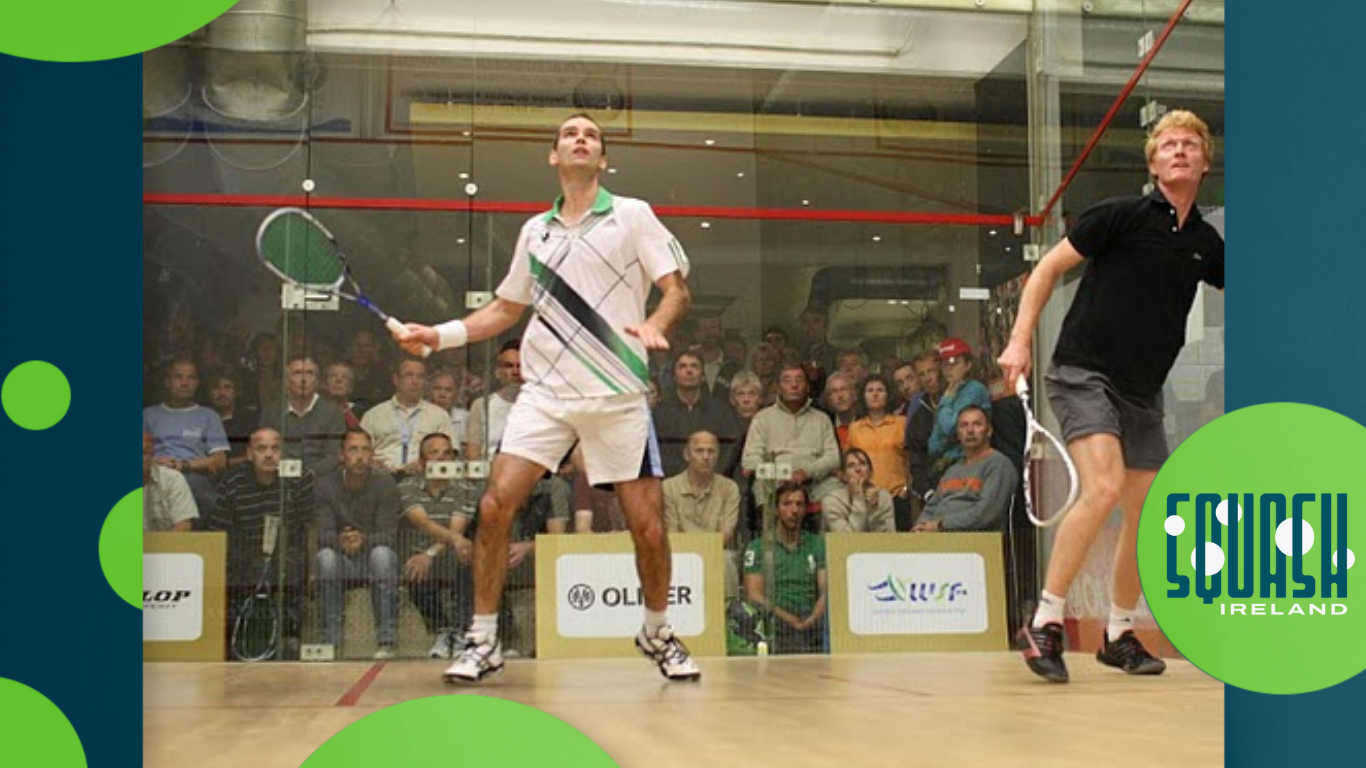
The legendary Derek Ryan was back on court at Fitzwilliam late on Friday night, rolling back the years to progress to the Leinster Masters Open M50+ semi-finals and he has since reached the Saturday 1:30pm showcourt final.
Before he dusted off his racket and togged out competitively for the first time since last May’s M45 Home Internationals appearance in Edinburgh, the former PSA men’s world No.7 took time out earlier in the week from his physiotherapy work for a life and times chat with Squash Ireland.
Now 56, the Dubliner, who won nine Irish Senior Nationals titles, enjoyed a 12-year stint as a player on the world circuit.
Aside from running his own physiotherapy practice from an office in Fitzwilliam, he has been the lead physio on the current PSA tour since 2017.
He has also recently started mentoring strength and conditioning to teenagers in the Squash Ireland Junior Performance Academy.
Before we publish our in-depth feature interview this Sunday with the Fitzwilliam player who started at Sandycove and also played at Dalkey, here is his On The T quick-fire Q&A:
MOST MEMORABLE MATCH: Probably two, really. One wasn’t a PSA event, but it was memorable because it was St Patrick’s Day and it was against Jansher Khan. It was only a league match, so you cannot take league matches on face value; PSA is what it is all about. Exhibition matches, practice matches, league matches, they really don’t count. But it was just a memorable win. I had never beaten him. I’ll take any win against someone like that, and it was St Patrick’s Day. Another standout was probably beating Rodney Eyles, who was world champion at the time, in Kuwait. I went on to get to the final and lost to Peter Nicol. That was probably my most memorable week.
BIGGEST INFLUENCES ON CAREER: I’d have to say my dad, Brendan, and Chris McManus, my coach.
BIGGEST MOMENT: Probably reaching the semi-finals in the Tournament of Champions in New York, in Grand Central Station. An amazing iconic venue, and it was basically the equivalent of a platinum event nowadays. I had a great run; I was hitting peak form. Lost to Jonathon Power in the semi-final quite badly, but he was an extremely good player.
BIGGEST DISAPPOINTMENT: There’s plenty. I was lucky I had a 12-year career. I have no regrets. That was the one thing, I got into the sport with no regrets, and I came out with no regrets. I would have done things differently. The biggest disappointment? Probably not making the final of a platinum event. I reached a couple of semis, and I never got to a final.
BEST SQUASH FRIEND: I would have to say Alex Gough.
FAVOURITE PLAYER: I am going to go back to a previous generation, and that was Jansher Khan, who was one of the best players in the world. Probably the main reason why I liked him was how he evolved his game. He was an incredibly gifted mover on court, and he could retrieve so many balls back that he created so much pressure. Then, as the years went on, he became incredibly accurate, so his short game was lethal in the end and he ended up being an all-round player, the full package.
MOST DIFFICULT OPPONENT: Australian Anthony Hill, who was ranked a couple of places above me. A difficult player because he was very, very good, with clever shot selection. I struggled against him for a couple of reasons: He was good, and I just never really got into his style of play. I found it difficult to play.
BEST SQUASH COUNTRY VISITED: Hands down, Egypt, for lots of different reasons. They dominate the sport.
FAVOURITE SHOT: Top spin backhand drop. I just used it a lot. I robbed it from a couple of players of previous generations and I just sort of adapted my own style with it.
BEST ADVICE: In my first year as a professional, don’t go and play tournaments in the summer because the summer is your training months. That was from a top 10 player, an English player. He said to train for three to four months and then try to enter bigger events. Go to events even if you are not in them. If someone pulls out, you’d be in the qualifying draw. That was the best advice I got because I hit the ground running on the circuit.
BIGGEST DRAG: Probably the earnings potential. It was a real slog because it was a minority sport. That was the biggest slog, but what doesn’t break you makes you, so there were positives out of that as well.
IF YOU WEREN’T A SQUASH PLAYER, WHAT WOULD HAVE BEEN: It definitely wouldn’t have been a professional sportsperson because I was brutal at every other sport I played, so that basically wasn’t going to happen. The answer to that, I don’t know. I did accountancy for one year, but I always had my eye on squash. The accountancy was just to calm me down for a year and then, all of a sudden, I said I am going to pursue squash full-time. Tricky question. I always looked at physiotherapy at a young age, so I became I physio and I think that is probably the route I would have taken. Physiotherapist, which I am now.
HONOURS: My best is reaching seven in the world, getting to the semi-finals of the Tournament of Champions, getting to the semi-finals of the Pakistan Open where I lost to Jansher Khan. I’m pretty proud of my Irish caps. I represented Ireland 213 times. They are probably my standouts, really; they mean the most.