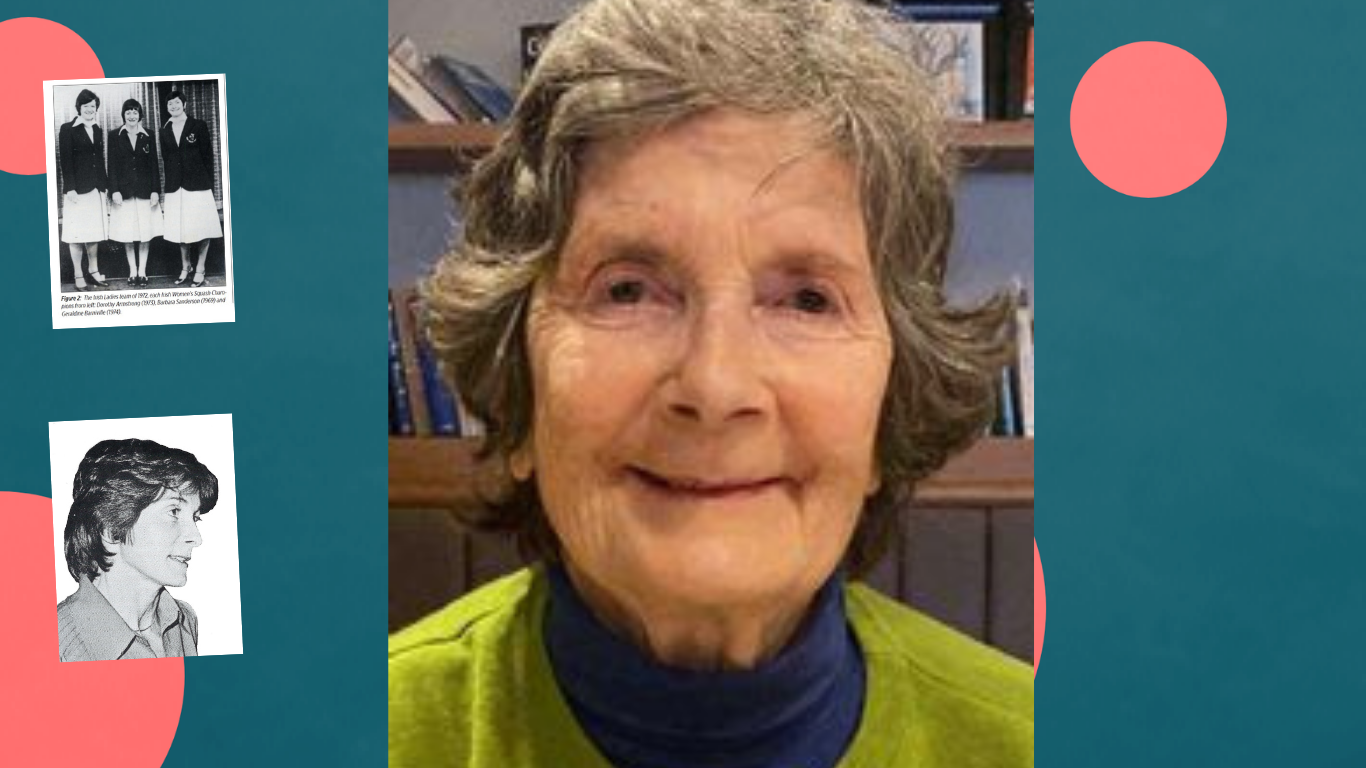
Irish squash has lost one of its standard bearers with the recent passing of Geraldine Barniville (née Houlihan), an indomitable player who was a member of the Ireland team that won the bronze medal at the 1974 World Championships – writes Ann Sheppard.
Capped 75 times by Ireland, she was also on the 1983 team that finished fourth at the Worlds and the teams that won 10 silver medals in the European Championships from 1978 to 1983. These achievements coined the slogan for Irish women’s squash – Squash players boast second in Europe and fourth in the World.
Geraldine also played in 10 Federation Cup (now Billie Jean Cup) tennis matches, was Irish No.1 from 1965 to 1974 and beat Virginia Wade (the 1997 Wimbledon champion) along the way.
Born in 1942 and a native of Birr, Co Offaly, Geraldine took to tennis at a young age before getting introduced to squash as a medical student at Dublin’s Mater Hospital.
She started to play more regularly in the early 1970s, was on the Irish team by 1972 and became Irish champion in 1974.
She interrupted a long-established Ulster dominance of Irish women’s squash – featuring Dorothy Boyd, Barbara Sanderson, Julie Morrison, Stephanie Lynas, Dorothy Armstrong and Irene Hewitt – and caused a stir after sewing a shamrock to a pillowcase as only a Union Jack was provided for the flag ceremony at an international event.
Geraldine joined Dorothy Armstrong and Irene Hewitt as the top three Irish players for well over a decade.
Unlike tennis, she was allowed play on men’s squash teams in the Leinster League. She held her own in the Premier League, playing for the Coombe, Old Belvedere and Leopardstown. Many a good Leinster male player’s pride was wounded but, in truth, it was no shame to be beaten by Geraldine.
She was held in high esteem by all her competitors, men and women, at home and also on the international circuit. She also played for Nomads, the Leinster ladies’ team that played in the men’s third division, and helped keep the team to its middle ranking.
However, after complaints from male opponents that she was too good, she was no longer allowed to continue playing at this level and had to confine herself to Premier men’s only.
She never played in the women’s league except for the inaugural Ivy Hadden Memorial Cup competition. Ivy was the first female coach in Leinster and a good friend of Geraldine. Geraldine played with Old Belvedere who, needless to say, claimed the trophy.
She also participated in Leinster training. As an admirer of tennis champion Martina Navratilova, who put a lot of emphasis on fitness, Geraldine did likewise and other members of the Leinster training squad always hoped that coach Alan Jerrold wouldn’t put them on the court with her as they would be put through the most rigorous and, at times, excruciating workout.
She would also bring along her calipers to check the squad’s body fat, measuring the loose flesh on the upper arm. She settled for nothing less than the best from herself and those on teams with her, driving on both Leinster and Ireland by example.
When she stopped playing competitively in the mid-1980s, she was instrumental in team preparation. Players had rigorous schedules they had to adhere to and were introduced to sports medics, sports physios, sports psychologists and sports nutritionists.
This was all unheard of in the world of squash five years earlier but the players now had to meet with Geraldine regularly to account for themselves. Becoming a top squash player was not for the faint-hearted, but Geraldine was always generous with her time and expertise with the top squash athletes, and she herself went on to do a Master’s in Sports Medicine at Trinity.
It wasn’t only as a player that Geraldine was a trailblazer. Aside from being the first to promote serious squash fitness training for women, she was instrumental in securing the amalgamation of the men and women’s associations and became Irish Squash’s first president.
She was also the first woman president of Leinster Squash and the first woman to become a member of the all-male Fitzwilliam Lawn Tennis club.
She was the go-to person both for Irish Squash and World Squash on anti-doping and represented World Squash on WADA. She also gave seminars at World Squash events for players on women’s health.
After squash, cycling became her passion and she completed many grueling maracycles at home and abroad.
Geraldine gave her all to everything she took on. She was a competitive high achiever who was determined and hardworking.
She was also an independent thinker, a straight talker and a person of high integrity. She loved good conversation, was extremely kind and caring and was a great pal.
Squash Ireland extends its condolences to her sons David, Tim and Nick and to her brother Jim and sister Susan. Ar dheis Dé go raibh a hanam.