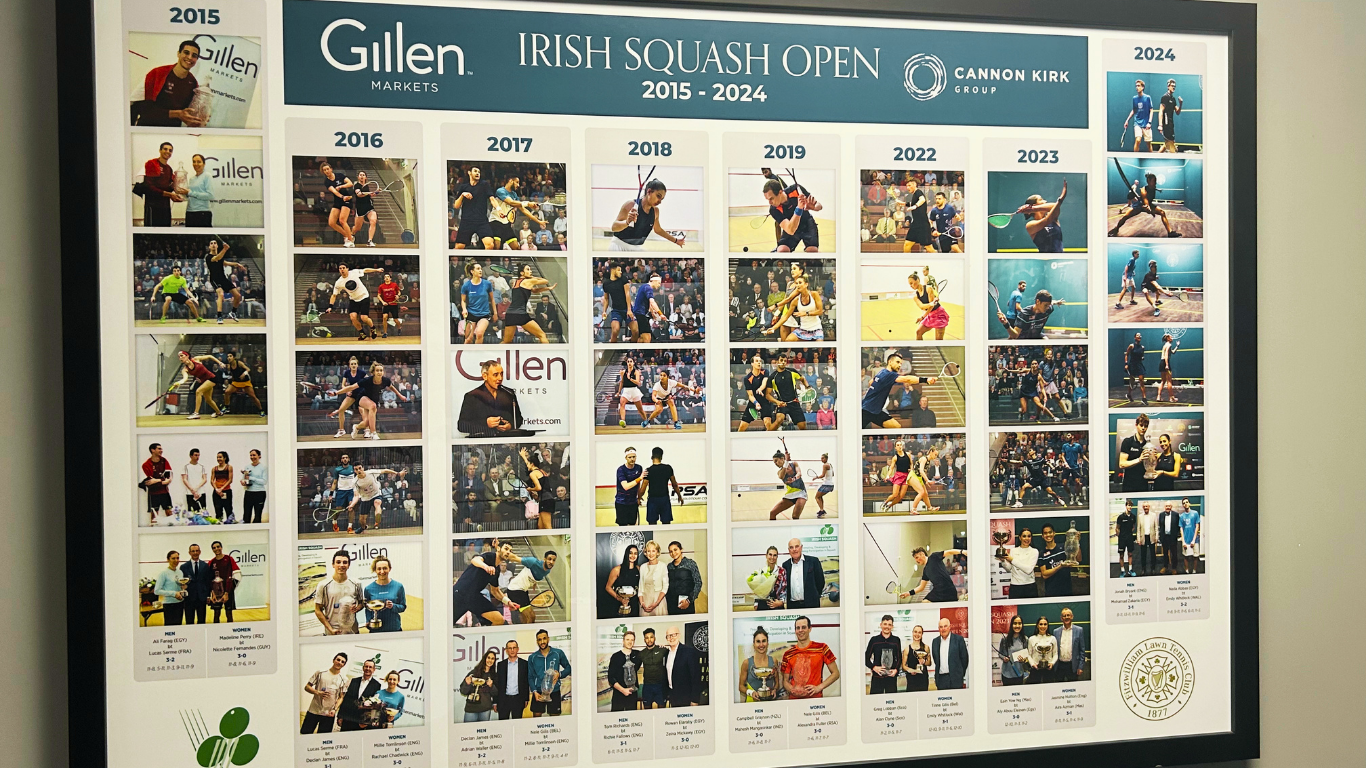
Quilter Cheviot Cannon Kirk will sponsor next month’s star-studded Irish Open featuring Jonah Bryant, the PSA men’s No.10 from England, and Nada Abbas, the women’s No.16 from Egypt. Both were the title winners in Dublin in 2024 (see main picture).
With only 32 days to go before the action at the five-day tournament gets underway at Fitzwilliam on May 19, it has been confirmed that Quilter Cheviot are on board as a title sponsor following its takeover last year of Gillen Markets.
The entry deadline has now closed, and the 24-player men’s line-up – made up of 14 nationalities – features 14 players ranked in the PSA top 70, including the defending champion from 2025, Scotland’s Greg Lobban.
Two Irish players will also take part: Sam Buckley, the Senior Nationals title holder and current PSA No.106, and Conor Moran, the No.152.
In the women’s section, the 24-player line-up – consisting of 12 nationalities – includes 15 top 70 players. Eight are from Egypt, while the two wildcards will be the Irish duo of Breanne Flynn, the PSA No.101, and Hannah McGugan, the PSA No.217.
Irish Senior Nationals title holder Hannah Craig was also set to feature, but she has now opted out following her qualification for the World Championship in Egypt from May 8th.
Craig’s success at last week’s European qualifying tournament in Pontefract meant she became the first Irish player since 2014 to secure a place at the World Championship – quite the achievement.
Both the men’s and women’s Copper status events have an equal prize fund of $41,500 each, an increase from last year’s $36K and way up on the $20K value in 2024.
Squash Ireland CEO Scott Graham enthused: “The Irish Open has attracted some of the top players in the world. We’re going to have an absolutely stacked field, and we’re delighted to have top Irish players as well… We hope to see you there.”
IRISH OPEN MEN’S ENTRY LIST
1. Jonah Bryant (PSA No.10, England)
2. Greg Lobban (No.23, Scotland)
3. Karim El Hammamy (Egypt, No.37)
4. Moustafa Elsirty (Egypt, No.38)
5. Matias Knudsen (No.42, Colombia)
6. Patrick Rooney (No.44, England)
7. Sam Todd (No.48, England)
8. Adrian Waller (No.52, England)
9. Nick Wall (No.54, England)
10. Ryunosuke Tsukue (No.61, Japan)
11. Sanjay Jeeva (No.62, Malaysia)
12. Shahjahan Khan (No.64, USA)
13. Perry Malik (No.66, England)
14. Muhammad Asim Khan (No.67, Pakistan)
15. Leandro Romiglio (No.73, Argentina)
16. Rory Stewart (No.75, Scotland)
17. Finnlay Withington (No.77, England)
18. Emyr Evans (No.81, Wales)
19. Duncan Lee (No.84, Malysia)
20. Rui Soares (No.86, Portugal)
21. Elijah Thomas (No.87, New Zealand)
22. Maceo Levy (No.89, France)
23. Sam Buckley (No.106, Ireland)
24. Conor Moran (No.152, Ireland)
IRISH OPEN WOMEN’S ENTRY LIST
1. Nada Abbas (No.16, Egypt)
2. Zeina Mickawy (No.29, Egypt)
3. Hana Ramadan (No.32, Egypt)
4. Nardine Garas (No.38, Egypt)
5. Nour Heikal (No.41, Egypt)
6. Nadien Elhammamy (No.42, Egypt)
7. Haya Ali (No.46, Egypt)
8. Habiba Hani (No.48, Egypt)
9. Joelle King (No.51, New Zealand)
10. Ainaa Amani (No.55, Malaysia)
11. Cindi Merlo (No.61, Switzerland)
12. Jessica van der Walt (No.64, Australia)
13. Madeleine Hylland (No.66, Norway)
14. Milie Tomlinson (No.68, England)
15. Kaitlyn Watts (No.69, New Zealand)
16. Tanvi Khanna (No.71, India)
17. Margot Prow (No.72, Barbados)
18. Saskia Beinhard (No.74, Germany)
19. Kiera Marshall (No.75, England)
20. Madison Lyon (No.77, Australia)
21. Enora Villard (No.83, France)
22. Ella Jane Lash (No.84, New Zealand)
23. Breanne Flynn (No.101, Ireland)
24. Hannan McGugan (No.217, Ireland)
Hannah Craig has described becoming the first Irish women’s player to qualify for the World Championships in 12 years as an amazing reward for all the people who helped her behind the scenes on her long journey to the top.
Not since Madeline Perry competed at the 2014 Championships in Cairo has Ireland had a representative at the tournament, but that will change next month when Craig, the PSA No.63, takes her place in the first-round draw.
The 64-player tournament at Giza, near Cairo, will pit Craig against Egyptian Sana Ibrahim, the PSA No.18, in the opening round after she lived up to her status as the No.1 seed for last week’s European qualifier in Pontefract.
It was no easy route to the title in England, as Craig had to start her campaign against fellow Irish player Breanne Flynn, and the pair produced a rip-roaring repeat of their recent Senior Nationals final at Fitzwilliam as their match again needed five games before producing a winner.
Craig took the fifth set 11-8, and she then went on to defeat Germany’s Katerina Tycova 3-1, Wales’ Lowri Roberts 3-2 and Poland’s Karina Tyma 3-2 to book her ticket to the World Championships in Egypt, beginning on May 8th.
Speaking to Squash Ireland from Germany, where she will play Tanvi Khanna, the No.71 from India, in the first round of the Sportwerk Hamburg Open on Wednesday, Craig explained her excitement at winning through to next month’s glamour event in Africa.
“It feels surreal right now and then in other ways, it kind of doesn’t because it is something I have put so much work and mental energy into preparation for this event,” she said. “Achieving it really feels so fulfilling. It was my biggest goal for the year, to play in the World Championships.
“The way I did that in terms of not getting into the main draw originally and then being seeded No.1 for the European qualification, I really felt like, ‘Okay, if I am going to get there, I’m going to have to prove I deserve that place’.
“Europe is definitely one of the strongest in terms of the continents, so I am really happy and it feels so rewarding that I was able to fulfil this and prove through multiple, very tough matches that I have earned that place in Egypt, so I can’t wait to be there.”
Reflecting on her four-match winning streak in England, Craig paid tribute to the quality of opposition provided by Flynn, the PSA No.101. “I had Breanne in the first round, and it was such a tough match. I knew that if I could get through that in terms of how physically and mentally exhausting it was, I would be in good standing for the rest of the event.
“That gave me a lot of confidence getting through that one, it felt like a final in many ways playing Breanne. I absolutely loved that battle again with her, and it helped me get through a couple of other battles later on in the tournament, in the semis and in the final.”
Twelve years is a long time for Ireland to go without a player featuring at the World Championships, and Craig dedicated her qualification to the people who unwaveringly supported her along the way. “It just means so much to be able to do it for the people that have really believed in me and spoke to the winner in me before I started winning anything,” she enthused.
“This has been a long journey, and a lot of people behind the scenes have been there. There was Brian Murray, who went to Pontefract to support me. He is a coach at Windsor in Belfast. He and I grew up together, playing at the Boat Club with Walter Murray, who is related to him.
“Just having someone there who had seen me since I was a junior gave me so much energy, and his support was amazing. Winning these things on a personal level is really nice, but it really is for all the people – the coaches, the sponsors, the friends and family – that have been there through the whole journey.
“The highs are incredible, but it is also in the tougher moments with injuries and losses and things that you really depend on those people, so I just want to thank everyone massively who helped and believed in my dream and contributed to that.
“Another person is Rory Gillen, of course. When I was a junior, he enabled me to play some tournaments around Europe, and he always said to me, ‘You have got to give the tour a try, you have got to give it a go’. I’m very grateful to be achieving something like this, and if feels even better that I have done it around the people who have enabled it.”
Stating that her body “feels surprisingly okay” heading into this week’s tournament in Germany after her exploits in England, Craig, who will represent Ireland at the European Team Championships at the end of the month in Amsterdam, wants to build on the momentum of her World Championships qualification.
“Getting this opportunity to go to Egypt and the World Champs, I just want to squeeze all of the juice out of that I can through competing, training and absorbing all of the highest level of squash that I can. It really is any athlete’s dream to put in the hours and then being in these environments to see and learn.
“I’m just really looking forward to being there. I am going to maximise every single thing that I can out of that trip and then finish the season on a high. I’ll have the British Open qualifying at the end of May and then I will be done for the season.
“That’s another very big qualification event and a large tournament. It’s one of the most prestigious tournaments for squash players, so I will be using this momentum and I’m very much looking forward to everything that is to come next.”
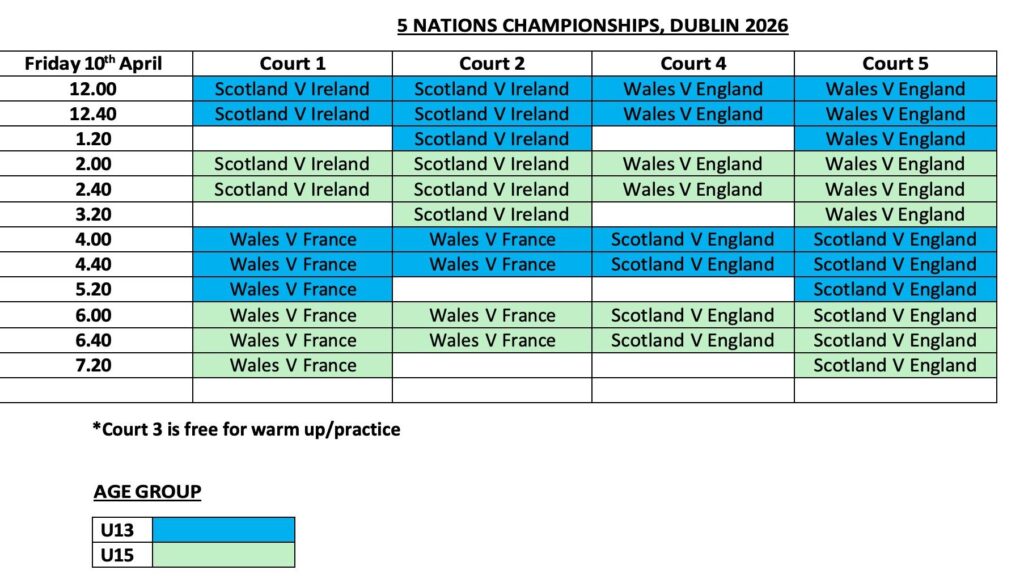
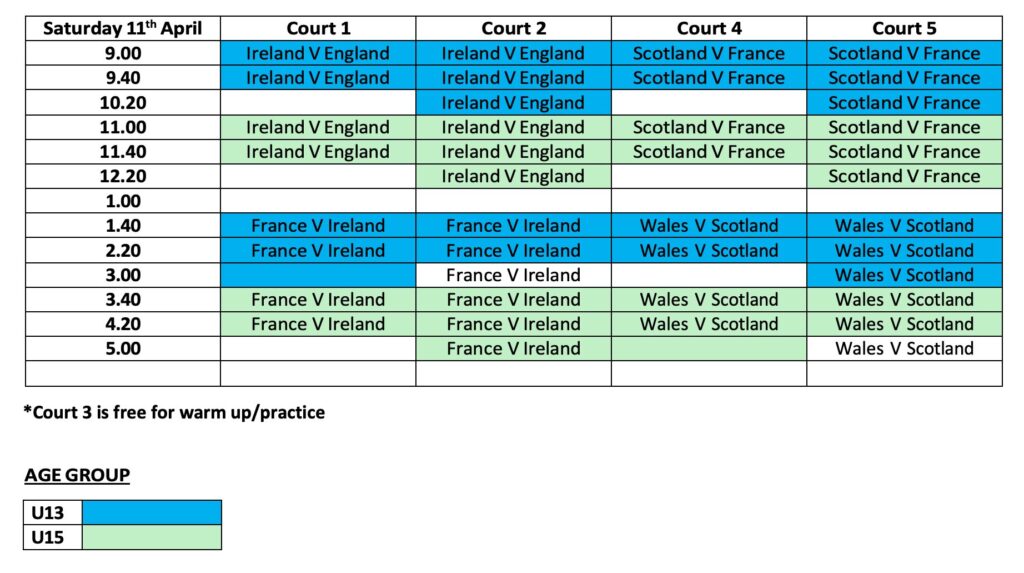
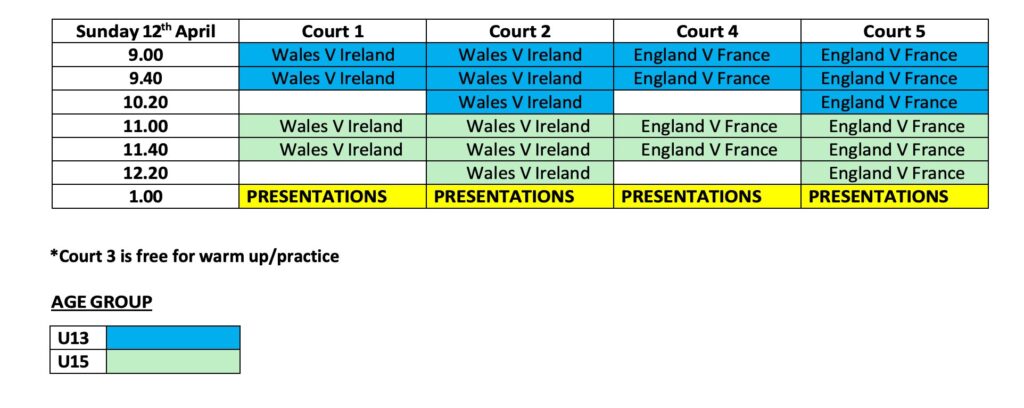
The eight-strong Ireland U13 team struck silver at last weekend’s Five Nations in Dublin, finishing second in their age-grade.
Coached by Michael Conroy, the Irish team consisted of Celtic trio Harry Knox, Caoimhe English and Daisy Morrissey, Mount Pleasant duo Ridit Thapar and Aurora McDonnell, Limerick’s Ruby Carroll, Sutton’s Eoin O’Brien and Belfast’s Josh Archer.
Following matches over three days, Ireland accumulated 27 points, a total that was good enough for second – six points ahead of France in third on 21 and 12 points behind the title-winning England on 39.
Scotland finished fourth on eight points, with Wales fifth on five points.
Ireland’s U15 team, consisting of the Mount Pleasant quartet of Michael Lai, Leonid Ivlenkov, Raghad Aboelala and Zoë Nyhan, Sutton duo John Quigley and Saibh Darcy, Belfast’s Gabby Curran and Celtic’s Jamie Morrissey, came fifth with four points.
England, who have dominated Five Nations squash for some time now, doubled up by taking the U15 title with 39 points, 11 ahead of France in second on 28 points.
Wales came third on 21 points, with Scotland fourth on eight points.
The Ireland MO40 team finished second at the Masters Home Internationals in Galway, with the WO35/40 and MO60 sides coming third and the WO60 team taking fourth place last Saturday.
Twenty-three players represented Ireland across the four teams in the first leg of the 2026 Home Internationals, and it was the MO40 skippered by Donnagh Crowley that fared best across the two-day event.
Crowley’s team, which included Brian Byrne, Michael Ely, Mark Furlong, Dermot MacNamara, David Noone and Niall Rooney, finished with 44 points from its three matches, 13 points behind the first-place England on 57.
Wales were third on 28 points, with Scotland bringing up the rear in fourth on seven points.
The MO60 team, skippered by Teddy Reinecke and featuring Gerry Callanan, Myles Fitzpatrick, David Hazzard, Donal Kelly and Andre Maur, came third.
They finished just five points behind second-place Wales on 32 in an age-grade won by England on 59 points. Scotland were fourth with 22 points.
In the WO35/40, the Siobhan Parker-captained Ireland, with Ciara Davey, Ciara Moloney Doheny, Aoileann Ni Chomhrai, Maria O’Brien and Tanya Scullion featuring, came third on 26 points.
They were 22 points behind the second-place England on 48 points in a table topped by Wales in 57 points, with Scotland finishing fourth on 18 points.
In the WO60, the Ireland team, skippered by Rosie Barry and featuring Josie Grogan, Mary Keyes and Diane Lanigan, finished in fourth place with one point. Scotland took the title with 36 points, England came second on 24 and Wales third with 17.
With the opening leg in Galway now complete, the action moves to Nottingham next weekend where another four Irish teams – the MO35, MO55, WO55 and MO75 – will take on their counterparts from England, Scotland and Wales.
Cassidy Travel, Ireland’s leading travel agent, has been named the Official Travel Partner to Squash Ireland. The sponsorship deal will see Cassidy Travel manage flights and travel logistics for Ireland teams travelling to major tournaments.
This includes the World Team Championships in South Korea, the Junior World Championships in Canada, along with key European Championships for senior and junior players over the coming year.
In addition, Cassidy Travel will develop bespoke travel packages for squash fans, providing opportunities to attend some of the most iconic tournaments around the world.
Squash in Ireland has been on the rise in recent years, with membership increasing by more than 30 per cent over the past two years and 12 new clubs affiliating with the all-island national governing body during the same period.
Squash Ireland has also been shortlisted for National Governing Body of the Year award for two consecutive years.
In a major boost for the sport, squash has been included in the programme for the LA 2028 Olympic Games and the 2027 European Games for the first time.
Ireland’s top-ranked male and female players have made significant progress in recent years and are now at or near their all-time high PSA world rankings, with their sights firmly set on qualification for the 2027 European Games and the 2028 Olympic Games.
Squash Ireland CEO Scott Graham said: “We are very ambitious for the organisation, and our top elite players are striving to compete at the highest level. The sponsorship and support of Cassidy Travel will be an enormous help in this journey.
“We have been working with Cassidy Travel for some time and can vouch for the excellent levels of customer service and their unrivalled experience, particularly in the area of sports travel. We look forward to continuing that partnership in 2026 and beyond.”
Sharon Harney, general manager of the Cassidy Travel Group, added: “As Ireland’s leading sports travel provider, Cassidy Travel is delighted to partner with Squash Ireland as their Official Travel Provider.
“Together, we will provide seamless end-to-end travel solutions for both athletes and fans alike. We manage the logistics for the qualifying Irish teams, so the players only need to focus on the scoreboard.
“Our extensive portfolio of exciting worldwide destinations, venues, and sporting experiences allows us to bring fans directly into the excitement of the crowd and the intensity of live sport.”
With the U19 European Championships in Krakow done and dusted, the junior international focus for Ireland switches this weekend to the U13 and U15 Five Nations in Dublin.
Sixteen players will feature for Michael Conroy’s Irish teams in their matches against England, France, Scotland and Wales at the three-day event being hosted by Sutton LTC.
The U13 team includes both Junior Nationals champions, Harry Knox of Celtic and Limerick’s Ruby Carroll, the Squash Ireland Junior Player of the Year.
Also featuring are Belfast’s Josh Archer, Sutton’s Eoin O’Brien, Mount Pleasant duo Ridit Thapar and Aurora McDonnell, and Celtic pair Caoimhe English and Daisy Morrissey.
Both Junior Nationals champions, Mount Pleasant’s Michael Lai and Belfast’s Gabby Curran, will feature in the U15 event. They are joined by Mount Pleasant trio Leonid Ivlenkov, Raghad Aboelala and Zoë Nyhan, Celtic’s Jamie Morrissey, and Sutton duo John Quigley and Saibh Darcy.
What they face is no easy task, especially as England have won both U13 and U15 titles for the last six consecutive editions of the Five Nations, including last year’s event in Nantes.
Acknowledging this English dominance, Squash Ireland junior development coach Conroy said: “I was involved in it last year, and we didn’t do too well.
“England are always generally very strong. It’s been a long time since anyone has beaten them at junior level. They always seem to pull away from all the rest of the countries in this competition.”
That said, Conroy doesn’t in the slightest downplay the level of promising talent representing Ireland this weekend, with plenty of title-winning names to get excited about.
He added that playing at home is an advantage, not only for the three Sutton players but also for everyone else in the squad as they are very familiar with the set-up at the north Dublin club.
“There is a lot of talent, and home advantage is a good thing, especially for the players from Sutton, John Quigley, Saibh Darcy and Eoin O’Brien, and everyone else is well used to playing in Sutton.
“It makes a big difference when you are used to playing on the courts. Squash courts are funny. People think they are all the same, but even at my own club at Leinster CC, it’s always a massive advantage.
“You always seem to play your best when you are playing on your own ground instead of travelling across the road to Fitzwilliam, even though you played there before. It’s a big advantage for our Irish teams that they are so used to playing at Sutton.”
Sifting through the names of the players chosen to wear the green, Conroy added: “The likes of Michael Lai, Jamie Morrissey, when they play competitions in Europe, they always do well, and Jamie won the Irish Open U13 final at Sutton last November. He has moved up to U15 and is the No.3 for the team.
“You look at Ruby Carroll, who hasn’t lost a junior match in something like over a year (at home), and she has gone up and won matches at Senior Nationals level and is still U13. She played the women’s A section at Fitzwilliam in February, which is a massive jump.
“Going through the list, they are all pretty strong. Ruby Carroll and Daisy Morrissey played in the Five Nations last year, and it was tough for them as it was their first year.
“They were playing a year up, but now they have all got that experience and are a year older, a year stronger – that makes a massive difference when you are a junior.
“Harry Knox is No.1 BU13s, and there is also Eoin O’Brien. Harry won the Spanish and Czech Junior Opens and was unlucky in the German Open. As a No.1, he is ideal because he has played a good few European competitions and every time he goes there he gets to between the quarters and the final.
“I don’t think in any of the ones that I have looked at that he has gone out in an early round, so he is ideal. Eoin O’Brien is another, and so is Josh Archer.
“Those three all played U13 last year in France, like the girls. So, five out of the eight were all involved in the Five Nations last year, and that is massive.”
Further fuelling the feel-good factor surrounding Ireland’s U13s and U15s is that they are arriving at the Five Nations near the end of Squash Ireland’s maiden year for its Junior Performance Academy, the structure formulated to provide more regular coaching and to better keep tabs on the development of players.
“Previously, I used to take the Ireland 17s and generally what used to happen was you’d get a couple of squads leading up to it, but that would be it for the year,” he said about national team preparations.
“This time round, we are with the players a lot more. I see them more regularly, and there have been a lot more groups leading up to this Five Nations. It’s more consistent over the year with the camps and all that sort of stuff.
“Apart from the additional coaching, I have seen them play a lot more. Previously, with the players on Irish teams, I would only see them play at Nationals or an Irish Open, but now that I have been sent away, I have watched them play at the German Open, the Danish Open, watched them play a lot more competitions overseas and here at home, interpros, you name it.
“I’m travelling with them a lot more, and that makes a big difference because you can bring it back then to squads, plan out squads around it and see what they need to work on because you are physically watching them beside the court at tournaments for three, four days. That’s huge, really.”
The value of this strengthened rapport can’t be underestimated. “It’s good, you get to know the kids and the parents a lot more. You’re not just getting on a plane with them, and they don’t really know who you are.
“They know you a lot more personally; you’ve sat down with them and gone through the stuff with them in detail, whereas before it was hard to talk in detail because you only had a limited amount of time.
“It’s much more beneficial this time round than the three previous years I did U17. I can see the difference, and I suppose the results are coming in; we’re getting much better results at European level, and hopefully we can pick up a few good results now at the Five Nations. We have a much better chance in Dublin than last year.”
It’s that most wonderful time of the year for Irish masters squash players, the annual four-leg Home Internationals.
Eighty-eight players across 15 teams have been selected to represent Ireland against England, Scotland and Wales.
The competition starts in Galway this Friday before moving on to Nottingham and Aberdeen and then finishing in Wales in early May.
A year ago, it was teams representing Ireland at MO35, MO55, WO55 and MO75 age-grades that played at the Galway LTC.
Twelve months on, the Threadneedle Road club will play host to 23 Irish players featuring on WO35/40, MO40, MO60 and WO60 teams that are respectively captained by Siobhan Parker, Donnagh Crowley, Teddy Reinecke and Squash Ireland president Rosie Barry.
This two-day event, which begins this Friday, will be followed by legs in England on April 17th-18th, Scotland on April 24th-25th and then Wales on May 8th-9th.
It was February 28th, following the completion of the Irish Masters Nationals in Dublin, when the Ireland team selections were announced, and Squash Ireland Masters committee chairperson Eugene Walker said the reaction was terrific.
“The teams were announced live. There was excitement, a feeling of pride, you know what I mean,” he explained.
“Look, the thing about it is when you represent your country, it’s a proud day. While these are masters players, they are no different than a 13-year-old kid making an Irish team.
“With masters squash, it’s different. Lots of these people, we’ll say, have played through the juniors, never made an Irish team and come in afterwards to play. It’s just being so proud to play for your country. It’s another level.”
Celtic club member Walker can’t wait to see what unfolds during Galway’s second successive year to host the Irish leg of the Home Internationals before the venue switches back to Dublin next year.
“Every two years, it goes between Galway and Dublin. This is the last year in Galway, and then it will move to Dublin next year for two years. It’s because of the court space; the venues each have six courts,” he said.
“Galway is a fine club. They have three glass-backed courts, and one of them has all-seating. It’s a proper venue. The visiting teams love it in Galway; it’s a lovely city.
“The Home Internationals is a massive highlight of the season,” he continued, “and we do have a few new players representing Ireland. In Galway, a first-time cap would be Marie O’Brien from Waterford in the WO35/40. The rest would have played before and might have played at senior level as well.
“Historically, England would probably be the strongest,” Walker added, assessing Ireland’s chances of first leg success. “Now I do think we have a chance in the MO40s in Galway, and we probably have a little squeak with the W035/40.”
The Home Internationals are taking place following a bumper domestic tour season for masters squash, with the numbers taking part in all the showcase tournaments handsomely up on previous years.
For example, there were 69 at last summer’s Waterford Masters, up from 40 in 2024. There was also a jump from 112 to 138 at the Leinster Masters and an increase from 100 to 122 at the Munster Masters.
Masters committee chairperson Walker, who doubles up as a tournament director, was chuffed with this exciting growth in popularity. “It was unbelievable,” he enthused. “We had the highest numbers we have had in years, like.
“We never had a number before like we had in Munster; the same in Leinster. And at the Nationals, we had massive numbers as well (154, up from 122 in 2025). Masters squash in Ireland just seems to be growing and growing every year.
“I don’t have any reason why, but it just seems to be so popular. For the last couple of months, I have been trying to think why it is getting so popular and I can’t put my finger on it.
“But we have people competing at O75s. We have one person, Michael McGrath from Limerick’s CIAC. He is 83, as far as I know, and he is playing the O75s.
“The players just seem to enjoy it, and it’s all good fun. Now, don’t get me wrong, it’s very, very competitive. But everybody seems to get on. It’s a good bit of fun, and there is a great bit of banter with everyone.”
IRELAND’S MASTERS HOME INTERNATIONALS TEAMS 2026
Galway, April 10th/11th
WO35/40: Ciara Davey, Ciara Moloney Doheny, Aoileann Ni Chomhrai, Maria O’Brien, Siobhan Parker ©, Tanya Scullion;
MO40: Brian Byrne, Donnagh Crowley ©, Michael Ely, Mark Furlong, Dermot MacNamara, David Noone, Niall Rooney;
MO60: Gerry Callanan, Myles Fitzpatrick, David Hazzard, Donal Kelly, Andre Maur, Teddy Reinecke ©;
WO60: Rosie Barry ©, Josie Grogan, Mary Keyes, Diane Lanigan.
Nottingham, April 17th/18th
MO35: Pieter Bekker, Rory Canavan, Michael Conroy, Mark Gilliland, James Judge, Peter McNeice ©, Sam Olwill;
MO55: David Cassidy, Tom Crowe, Stephen Fasenfeld ©, Brian Lalor, Adrian Leeson, Stephen Mooney;
WO55: Sarah Berkeley, Jennifer Dillon, Danielle Donohue, Lynda Dunlop ©, Emer O’Brien, Beverley Scott;
MO75: Paddy Butler ©, Seamus Daly, David Gotto, Michael McGrath.
Aberdeen, April 24th/25th
MO50: David Ayerst, John Hurley, Neal Murphy, Vincent Pippet ©, Dave Riordan, Derek Ryan;
WO50: Kinny Bolton, Aisling McArdle, Rachel McNulty, Sue Murphy, Suzanne O’Shaughnessy, Suzanne Swan ©;
MO70: Bert Cotter, Donal Coughlan ©, Michael Conlon, Robert Garvin, Patrick Hanley, Kyran Hurley, Peter Stephens.
Cardiff, May 8th/9th
MO45: Kevin Knox, Neil McCarron, Kevin Moore ©, Patrick Morrissey, William Nicholson, Nigel Peyton, Ronan Peyton;
WO45: Suzie Connors, Niamh Darcy, Rachel McNulty, Sarah Scanlan ©, Suzanne Swan, Sandra Walshe;
MO65: Gerard Connaughton ©, John Dineen, David Lalor, James McSweeney, Michael Roden, Nicky Rusk;
WO65: Maureen Duke, Rose Hynes, Marian Mullen ©, Dympna Reardon.
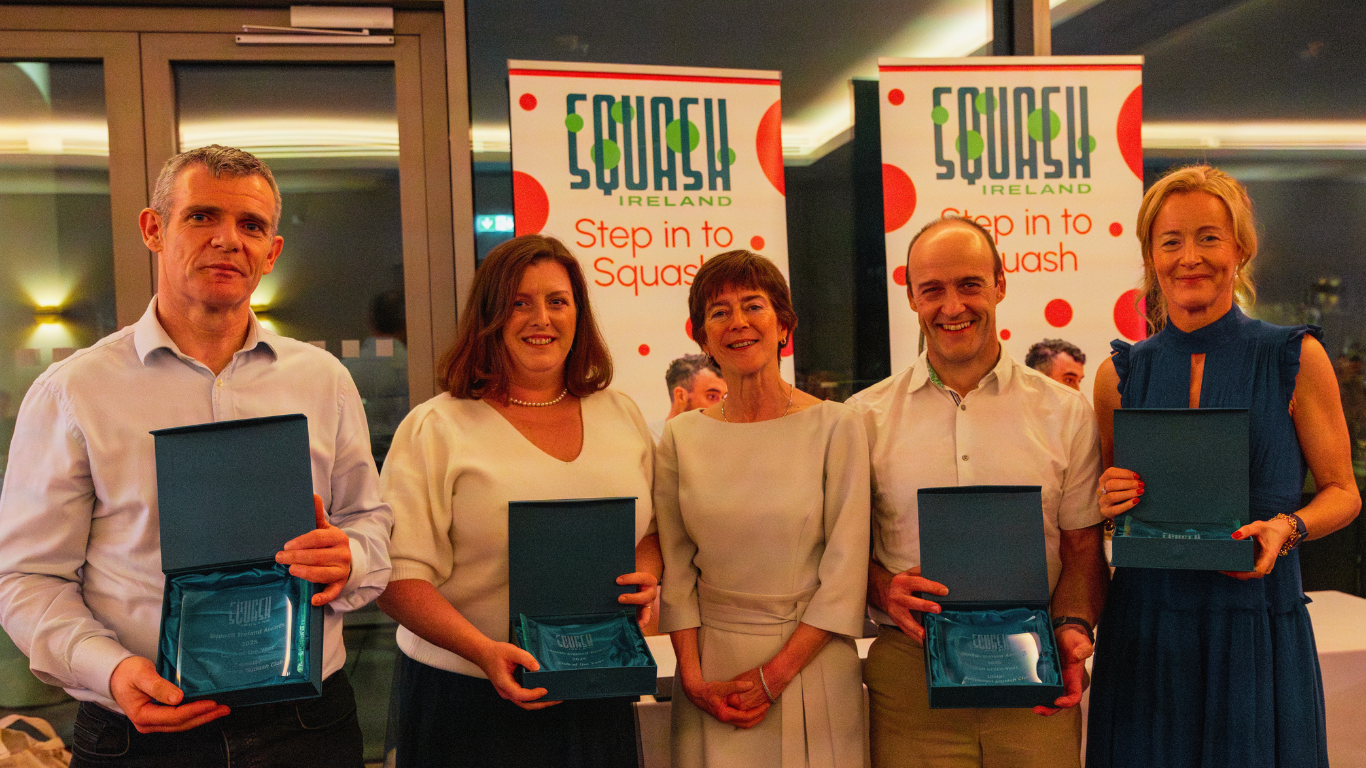
It was the final piece of the jigsaw at the recent Squash Ireland awards, the revealing of the National Club of the Year winner.
Ballymena, Galway, Highfield and Tullamore had all just been presented with their respective best-in-province awards… and it was the Leinster representative that ultimately took home the big one.
What stood out, according to the judges, was how the Co Offaly club was “well organised, ambitious and constantly looking to improve, becoming a benchmark and trailblazer for clubs of similar size across the country”.
Club captain Morgan O’Donnell and member Imelda Murray were blown away. They had travelled the 100 kilometres up to Fitzwilliam more in hope than expectation, but what materialised on the night was a vindication of “the energy, patience and dedication within the club to accelerate development and strengthen its community.”
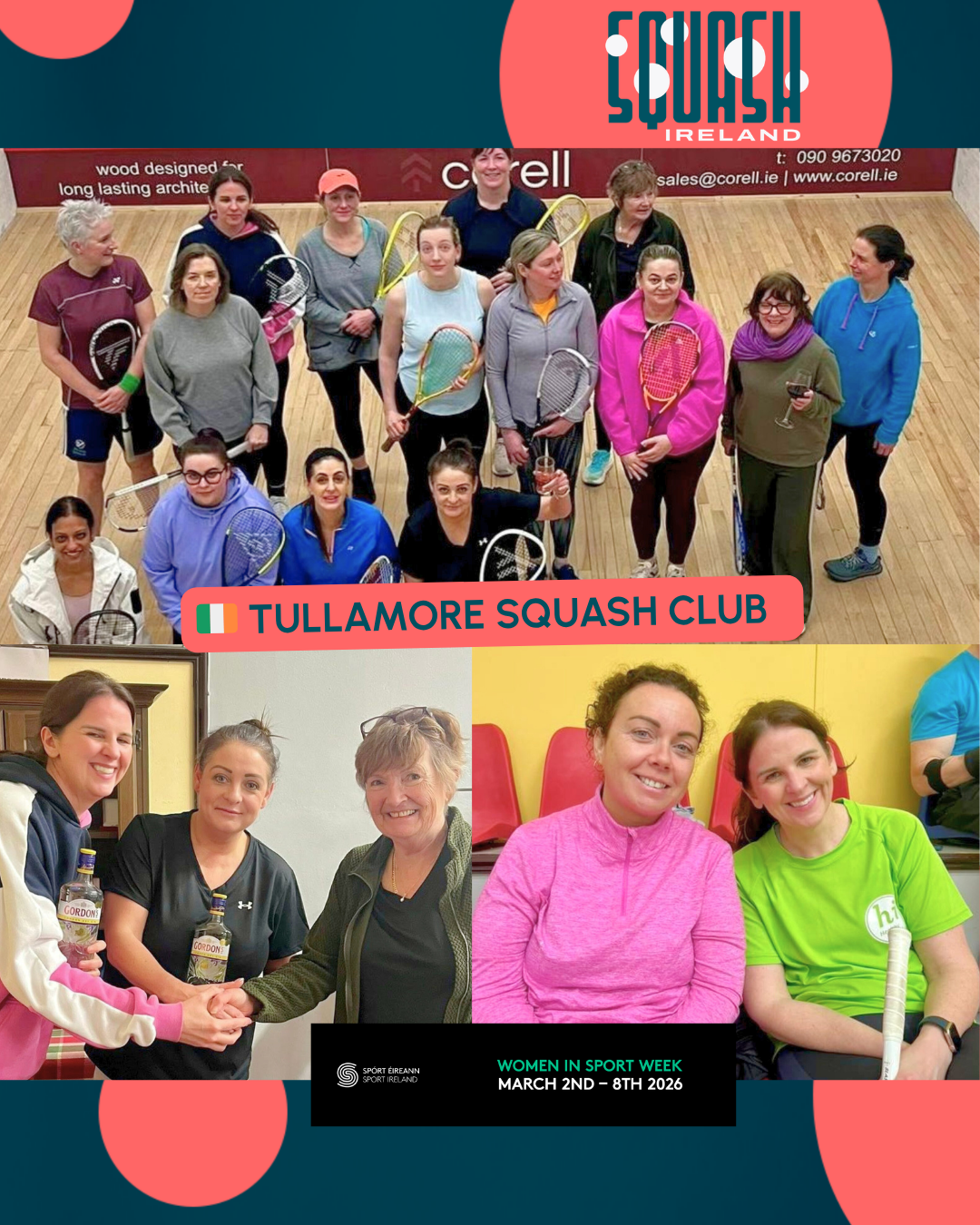
Tullamore SC has been around since the 1970s, but the three-court set-up at Puttaghan has never been busier than it currently is.
The list of activities across the week is extensive: Saturday coaching for all levels, six‑week blocks of Leinster League training, Wednesday women’s coaching, Friday night mixed‑level round robin, Junior coaching every Saturday plus extra midweek sessions, three ladies’ HIIT blocks per year to help get more women into squash, social blitz tournaments and a year‑round internal league.
It’s a lot done, but there is plenty more to do, according to O’Connell, when Squash Ireland caught up with him some weeks after the warm glow of Tullamore winning the National Club of the Year award had fully sunk in.
From his perspective, becoming a more regular participant on the Leinster League circuit in recent years had opened the eyes and concentrated minds about what could be achieved. “Throughout the years, there have been a few teams entered in the Leinster League; it depended on who was running the club at the time,” he explained.
“I can’t give you a number of how many times we have entered over the last 20, 30 years, but I would say once every few years that a team got thrown in and then it lost momentum, and it didn’t get thrown in again for another five years or whatever.
“But the last two or three years now we have had our main team in, our men’s As in, and then once the ladies started getting interested and more players started coming to the club, we decided to throw in another two teams this year, which was great.
“We’re up to about 80 or 90 members now and since we started playing the Leinster League, our members have noticed how other clubs develop, noticed better facilities and a lot of the players playing in the Leinster League are getting involved in the club now.
“They want to grow the club; they want to get the club up to a certain standard now, so there is a fair bit of motivation now with regards to what the members want to do and where they want the club to go.”
Bolstering this ambition to spruce things up is the momentum in the women’s section, with the doors also thrown open to encourage junior-level growth. “Since we started the HIIT programme, we have had an awful lot of interest,” O’Donnell continued.
“Squash Ireland funded our first HIIT programme, and this is our second one this year. We have now started a ladies’ training night every Wednesday. It seems like where there is structure in the club, activities are going on, people are more willing to partake and that is where the membership growth has come from.
“Now we have a lot more juniors, about 30 rotating in the 10-week blocks we are doing. We don’t enforce membership for the juniors, it’s just getting them used to squash, but what we have noticed is the families are getting interested from coming down to the club, realising what is going on in the club and we are after taking on about seven or eight new families just from the juniors.”
Essentially, Tullamore’s warm welcome has gone a very long way in making a lasting impression. “There is a buzz in the club because of the community we have developed. When you come into the club, people are hanging around, people are talking.
“The Leinster League, any of the home games, they are getting advertised and people are coming down to watch. Some of the visiting teams come down and go, ‘Oh my god, 20 people are watching the game. We don’t have that at our club’. That is definitely attractive.”
Attractive, but with the vignette that there is still much room to get better. “Between four and eight o’clock every evening, two courts are nearly always flat out but we don’t have enough power in the club.
“Our third court is not very warm and people are very reluctant to play on the third court. People are waiting to get court one and court two rather than court three, so court three is used as a last resort type of thing. But we are in the process of upgrading things, so hopefully this time next year we have all this heat that is needed.”
Growing the junior section is also on the agenda. “A lot of players wouldn’t have hand-eye coordination, so we really are starting from scratch, just getting them holding a racket right, hitting balls.
“We can’t really progress with most of the juniors until they are at a stage where they are actually able to hit a ball well, but we do have one or two players coming through in the boys and girls juniors who are developing quite fast. They have come from GAA backgrounds, so they have hand-eye coordination.
“One of the juniors is going to start playing with me, Brian Lalor and Saki Muhammad, which will be a good, fast development. We do have a round-robin in place for the juniors that gets them to a certain stage, but we want to get them to where they can start playing with us.
“You need a structure in place to keep kids involved. You need a warm environment. Our club is a little bit dated; it’s not very welcoming, so we are in the process of making it a welcoming club that kids will actually come down to because none of the juniors are actually coming down to play on their own; they are only coming down to the coaching lesson, so we need to change the structure.”
O’Donnell himself was smitten by the sport at junior level, and it remains a regret that, for whatever reason, he stepped away at the age of 16 and didn’t take squash up again until 14 years later when, by chance, he played a game with his son on holiday.
“I started at 14 but stopped playing when I was 16,” he said, recalling his squash journey. “My best friend at the time, Anthony Frahill, we went hell for leather at it when we were kids for two years, just played non-stop, got coaching from Eoin Ryan up in Sutton.
“We used to go up there and we played on Leinster teams. Anthony went on to be Junior No.1 at U19s, but he passed away about nine years ago.
“I played for years and then I stopped, only coming back when I was 30. My eldest son, when we were over in Canada, we went to play on a squash court and he loved it. So we went into Tullamore and the young fella started playing, started playing quite well, and he went down the same route.
“I set him up with Eoin Ryan for coaching and he started playing for Leinster and made squads. But there were no other juniors here at the time, and he stopped when he was 19. He’s travelling at the moment, but hopefully he’ll come back to it.
“He did come back from his travels last year, and I asked him to do one of the coaching sessions. He went to the club and went, ‘Oh wow, there is actually a community here, there is a nice vibe here compared to when I was playing’.”
O’Donnell’s own break from the sport remains a frustration. “It’s probably the only regret I have in life,” he reckoned, looking back.
“I realise I have a certain determination about me and I reckon if I had just kept on in the loop when I was that age, especially with the lads about me, I could really have had a fruitful squash career. It is my biggest regret, it really is, but circumstances and life get in the way.”
Junior Nationals champions Aaron Knox and Shriya Drawid have finished as the highest-placed Irish players at the four-day U19 European Championships Individuals in Krakow.
Celtic stalwart Knox [17/24] clinched 27th place in the 64-player BU19 with a 3-1 win on Tuesday over Poland’s Karol Krzywina [25/32].
The next-best of the Irish boys was Sutton’s Christian Dromgoole [17/24] in 37th. He beat his brother Tyler 3-1 on Tuesday morning before getting a walkover against Vince Czako [25/32].
Tyler, meanwhile, went on to pip Fitzwilliam’s Frank O’Flynn to 39th, winning their campaign-ending play-off 3-1.
In the 53-player GU19, Belfast’s Drawid [25/32] finished her tournament with a 3-2 win over Spain’s Olivia Mon Real to secure 21st.
Next best was Mount Pleasant’s Riley Slade [25/32] in 26th. The American-based Ella Erickson came 34th, with Sutton’s Zoe Yeomans [17/24] one place behind in 35th after her closing 3-2 win over England’s Eve Parkins.
Excluding the two all-Irish fixtures in the BU19, Ireland’s overall match record at the Championship was W23 L19.
With the Individuals now over, attention turns to the Mixed Team event. Seeded No.11, Ireland are drawn in Pool B and will play England [2] on Thursday followed by Belgium [7] on Friday.
There are now just 50 days to go before the start of the 2026 PSA Irish Open at Fitzwilliam, a star-studded tournament headed up by Egypt’s Nada Abbas, the PSA No.15 women’s rank, and Scotland’s Greg Lobban, the PSA men’s No.22 and defending Dublin champion.
With the entry deadline soon to close, the provisional start list for the Copper status event will leave Irish squash fans salivating.
There are currently 11 of the world’s top 62 women’s players, including Ireland’s Hannah Craig, on the start list for the 24-player event.
The quality will be just as high in the 24-player men’s section as 10 of the world’s top 58 have already registered to play.
Both the women’s and men’s events have an equal prize fund of $41,500 each up for grabs, and the five days of competition are sure to be intense when it begins on May 19th.
Aside from Craig, other star Irish names such as Sam Buckley, the PSA men’s No.107, Conor Moran, the men’s No.153, and Breanne Flynn, the women’s No.100, will feature.
Egypt have the dominant representation in the women’s section as eight of the top 10 ranked players that have entered hail from there.
Aside from Abbas, their other leading entries include No.27 Zeina Mickawy, No.30 Hana Ramadan, No.42 Nour Heikal, No.45 Amina El Rihany, No.46 Nadine Shahin, No.55 Menna Hamed and No.61 Habiba Hani.
Looking to break this Egyptian stronghold will be No.51, Marie Stephan of France, England’s Alice Mead, the No.57, and Ireland’s Craig, the No.62.
Switching to the men’s field, aside from 2025 champion Lobban, some other high-profile entries include the PSA No.27, USA’s Timothy Brownell, the No.41, Pakistan’s Muhammad Ashab Irfan, and the No.43, Egypt’s Moustafa Elsirty.
Meanwhile, the No.44, Patrick Rooney, heads up a strong England contingent that also features No.48 Sam Todd, No.50 Adrian Waller and No.52 Nick Wall.
Squash Ireland CEO Scott Graham enthused: “The PSA Irish Open is one of the marquee events in the calendar every year. It’s huge, and this year it has Copper status again with a big prize fund equally split between the men and the women.
“It has attracted some of the top players in the world. We’re going to have an absolutely stacked field, and we’re delighted to have the top Irish players as well.
“Given that their world rankings have been improving every year, they are going to be really competitive again this year. We’re really looking forward to seeing how they get on, and we’re going to have great crowds watching this year.
“Squash Ireland are working with Fitzwilliam, who do a fantastic job hosting the tournament every year, to organise some participation activity during the tournament as well. Watch out for more news on that. We hope to see you there.”