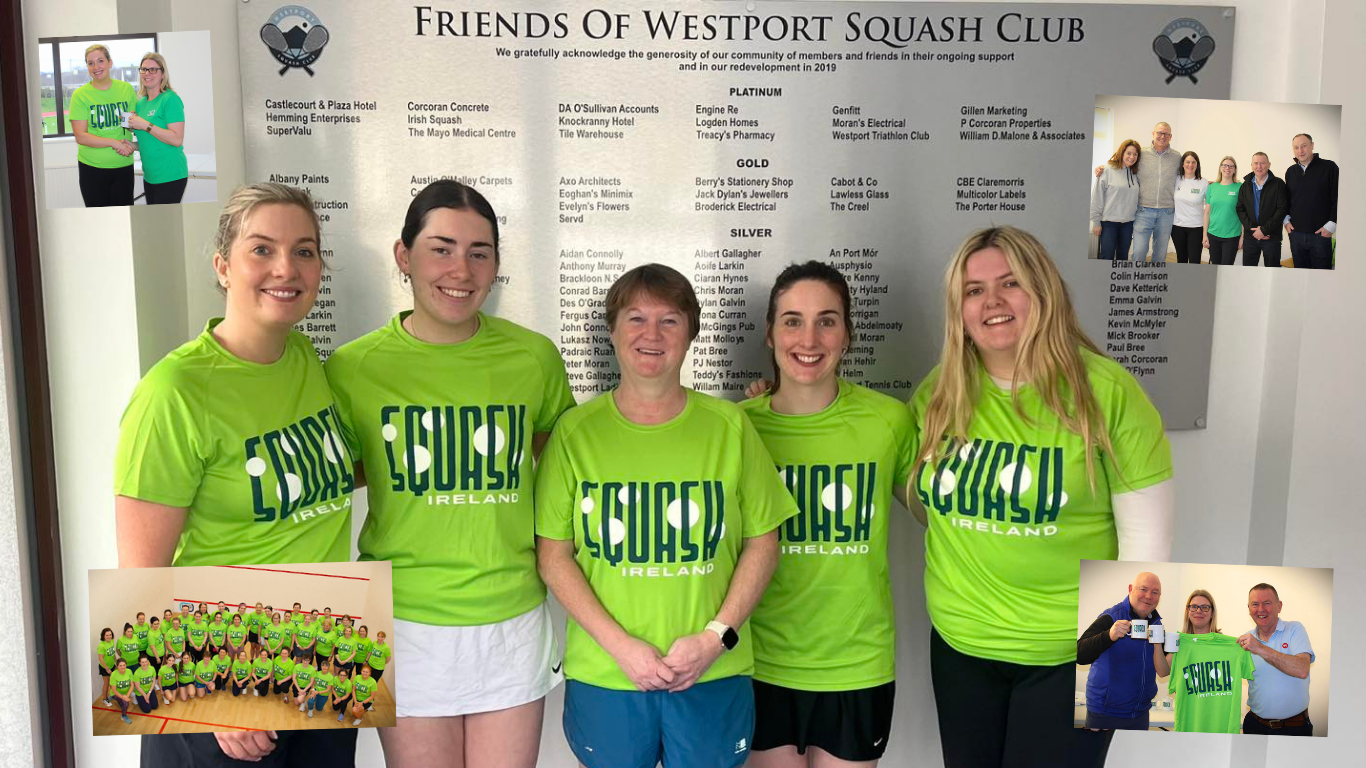
Squash Connacht president Paul Bree had to pinch himself after walking into Westport Squash Club on Horkans Hill last Sunday. Forty women’s players from six different clubs – hosts Westport, Galway, Claremorris, Loughrea, Sligo and Ballina – had turned up for a Swiss pairs event featuring eight-minute matches.
There were, of course, winners when everything had shaken out by the end of the afternoon (Galway were the best overall team with Claremorris’ Nina Wallace topping the Division 1 Individual). The bottom line, though, had emphatically been achieved.
“The emphasis wasn’t on winning, the objective of the event was to get clubs back in the mindset of fielding women’s teams, getting women together in their club and going somewhere because that is what used to happen before,” Bree enthused, careful not to take any credit away from event organiser Fiona Gallagher.
“I was nervous asking Fiona because she is a busy woman and thought she would say no, but she didn’t and with back up from the women on our committee and a lot of the lads, I couldn’t believe it when I went in last Sunday morning.
“The first thing that went through my head was, ‘This is great’. There were 40 women, a range of abilities, the club was buzzing, there was catering in place, Dave Broderick (Squash Ireland’s club and community development officer) stuck his head in and brought prizes, and there was a very good vibe for an extremely busy day.”
The hope is that a successful foundation has been laid for a four-team women’s spring league. That would be some going, given how just a single club – Westport – entered last year. It would represent another win for the slow but sure rejuvenation of squash in the West in the last few years.
Taking over the Connacht reins wasn’t something on Bree’s bingo card. Originally from Westport, work down the country saw him first step into squash in 1978 at Limerick LTC, switching over from tennis. There was also time spent attached to Galway and in Castlebar, when the largest Co Mayo town had two clubs in the 80s, before settling into helping his native Westport evolve.
“Westport was a two-courter, and we were lucky to hit a point in our history where we had a lot of committed people together at the same time,” he explained. “I would have joined the board of Squash Ireland as a Connacht rep about four years ago and with structural changes, the branch structure was modified and I kind of was just handed the role of Squash Connacht president.”
Bree’s appointment sounds accidental, but the evolution in Connacht on his watch has been progressive. “Squash in Connacht had been kind of stationary and gone slightly back the last five or eight years. A lot of people blame covid for a lot of things but while it didn’t help, I don’t think you could blame covid for everything.
“Some clubs that only had one court struggled disproportionately because you are limited by playing numbers. With limited playing numbers, you are limited in the number of committee members and people prepared to share the burden. To my mind, the decline was most evident in clubs with one court.”
So what tactic was adopted to give the sport a lift? “We have tried to replicate in Connacht what worked for us in Westport. That was a monthly cadence of meetings, whether we needed one or not, and we got people who had moved a bit away from squash to come back in and drop into the meetings.
“We got a small bit more energy going in the last 12 months and got clubs starting to talk to each other a bit more than just playing a game against each other occasionally. We found that by having a structure similar to the structure we would have had in the good old days, we started to make progress on several issues.
“This season has been good because we hit our stride with regular formal meetings, minutes and we got people to kind of take roles. Last year, we danced around it. We didn’t want to hang a role on someone’s neck in case they got frightened. This time, we cajoled people into taking on specific jobs and doing them, but we didn’t burden them with a title.
“We have a functioning committee now – the core of treasurer, secretary and me as chairperson – who push stuff along, but it’s open and very transparent. We run our meetings on an open church basis, where every month anyone can join the meeting from any club.
“We have kept the meetings to one hour religiously, and we don’t send out a whole list of actions to people. We instead try to keep the actions relevant, and we communicate more. Over the next 12 months, if we keep that level of engagement, we will get more stuff happening.
What’s been achieved and what’s next? “We decided we needed to get a couple of wins on the board, so the women’s cohort was an obvious one because that decline was more precipitous than the men’s one.
“Our club in Westport has, for the last five years, actively recruited women. We had a formula that worked, but we felt that if we could get other clubs to come together and send women to an event such as last Sunday, it would be the grit in the oyster.”
In time, an overarching Squash Connacht plan will be agreed but for now it’s about strategic small gains. “A plan is too grand a word,” said Bree, whose own tuition in the role is bolstered by the provincial president’s forum chaired by Derek McGrath (Sport2Sport).
“What we are trying to do is get stuff happening tactically. We have made progress on getting more involvement from all the clubs, rather than one or two trying to drive things. We have run a league fairly well for the last four years, and we’d like to grow participation in that. It’s a men’s league, really, but some elite women play for some teams in it.
“We’d like to grow that and maybe get a few clubs that are moribund to field a team, but that is a challenge. To get a club back up and running after having it moribund is a lot harder than jump-starting a car. A lot of bits have gone missing over the years.”
The list reeled off by Bree was a reminder of how widespread squash used to be. “Places that had clubs were Kiltimagh, Swinford, Crossmolina, Kilconly, Padraig Pearses GAA on the Galway-Roscommon border. I think there were Athenry and Tuam.
“From the 70s and 80s, there was a necklace of squash clubs attached to Gaelic football clubs, but people got older. There was no succession plan in place in the clubs, and people just got tired.
“There are a couple of clubs you can get back, but there isn’t a magic bullet – and it’s not just money. Money adds rackets, balls, t-shirts. That will help a bit, but it takes one missionary in a community to get it going. It could be a school principal, a retired hurler… I don’t know, but we compete with Gaelic games and it’s tough.”
Tough but not insurmountable. Last Sunday’s successful one-day women’s blitz in Westport highlighted that.